Keynote D · Division 07 Joint Sealants
Sealant & Expansion Joints
Masonry gaps, concrete expansion joints in sidewalks, parking lots and foundations, and roof expansion joints, cut out and resealed so a New Orleans building can move without letting water in.
Why a sealant bead gives up in New Orleans heat
A building is never still. Brick and concrete swell in a New Orleans summer, shrink on a cold January morning, and the whole structure settles a little more each year in soft Gulf Coast ground. Expansion joints exist so that movement lands in a planned gap instead of in a crack through the wall.
The sealant in that gap has the hard job. It has to stretch and squeeze with the joint, hold to both edges, and shed water all day long. When a bead hardens, splits down its middle or pulls away from one side, the joint stops being a sealed gap and becomes an open channel. Rain follows it behind the brick, under the slab and into the roof deck.
Sealing a joint keeps that water out and keeps movement from turning into cracks, which is why a failed bead is worth fixing before the wall around it shows damage.
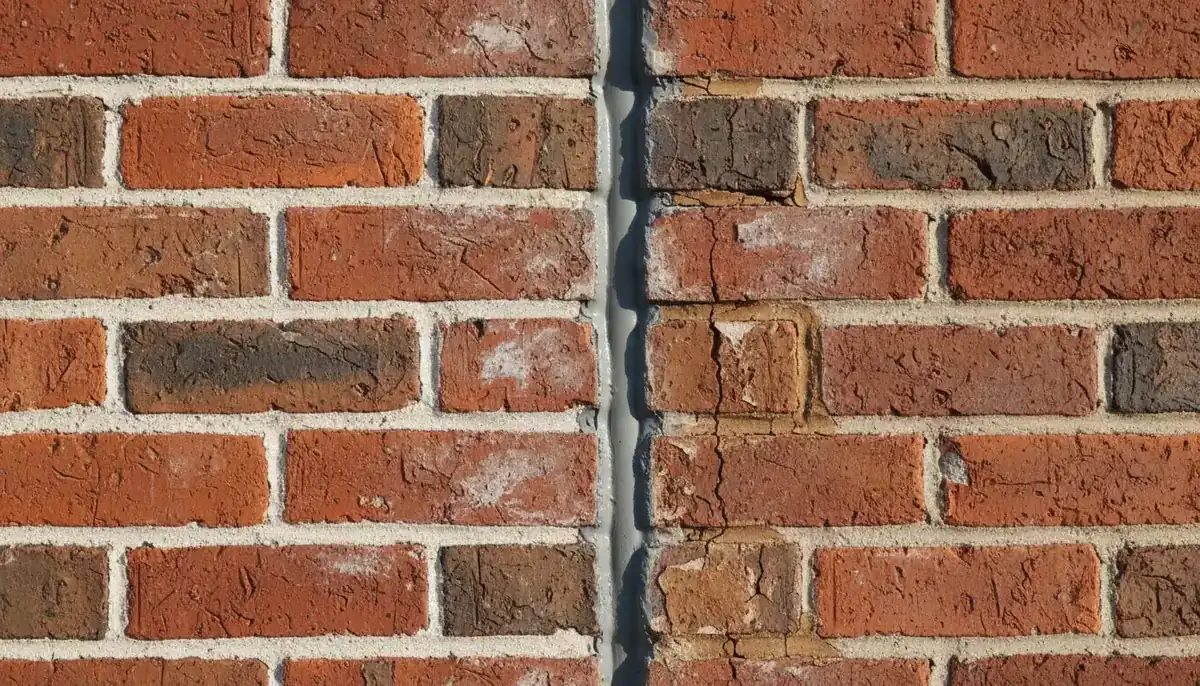
Grey sealant bead tooled into a vertical joint in a red brick facade
Masonry gaps, concrete slabs and roof joints
Masonry gap sealant is the first of the three joint types Paramount seals. Brick walls open along head joints, at corners and wherever one material meets another, and a flexible bead fills a gap that rigid mortar cannot. The result is a tight seal that stops water from working its way into the wall.
Sealing Concrete Expansion Joints covers the flat work: sidewalks, parking lots and foundations. A slab with a dead joint breaks at its edges, lets water in underneath and washes out the base, so the bead is what keeps a parking lot from coming apart at the seams.
Roof Expansion Joint Sealing is the third. A roof takes the sun directly and moves more than a wall does, and the joint across it is where a leak tends to start. Sealing that line protects the roof from thermal expansion and contraction and closes the weak spot before it opens.
Cutting out the old bead and tooling a new one
A joint redo runs in a fixed order. The failed sealant comes out completely, because new sealant will not hold to old. The joint faces are cleaned back to sound, dry masonry or concrete. A backer rod is set to the right depth so the new bead has a shape to take and does not bond to the bottom of the joint. Then the sealant goes in and is tooled so it presses firmly against both sides.
Windows are joints too. On the Holiday Inn on the Westbank Expressway in Gretna and on The National Rice Mill at 522 Montegut Street, Paramount's listed scope includes window glazing and caulking alongside the façade work around them, and the Holiday Inn job was completed without interrupting the business.
If you can see daylight in a joint, or a bead that has gone hard and chalky, text a photo to 504-723-4112 from anywhere in New Orleans. Paramount calls back to set up a visit and an estimate.
Window glazing and caulking were part of the listed scope on the Holiday Inn on the Westbank Expressway in Gretna and on The National Rice Mill at 522 Montegut Street in New Orleans.